Motivation
Most linear regression models assume
The standard closed form for this, obtained via finding the MLE estimate, gives
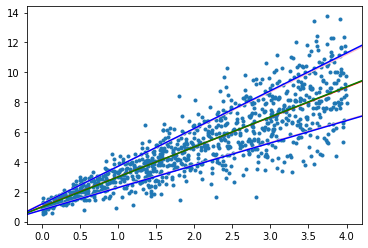
However, the variance need not always be constant. Consider a model where the variance is varying linearly (or rather just increasing) with
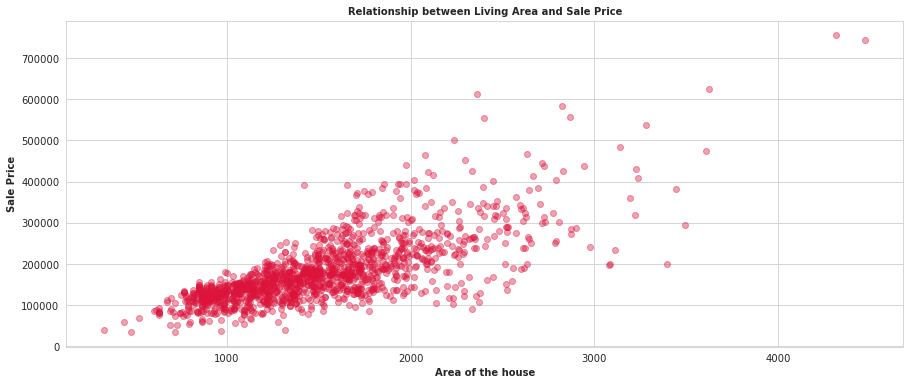
While there are feature transformations that would make this less heteroscedastic, this article focuses on learning the variance parameters, so along with our regression estimate, we can provide a variance estimate as well
The Model
We assume that the standard deviation (not variance) is a linear function of
The log-likelihood function is hence
Differentiating with respect to
Rearranging this gives us, in a matrix form,
Where
The derivative with respect to
An Implementation
Implementation was fairly straightforward, using gradient descent, and it converged nicely to some generated data