This note on random variables follows as a result of confusing notation in several math textbooks. I’ll explain random variables (in measure theoretic terms) as verbosely as I can, and then prove some results. This article assumes that the reader is familiar with probability triples
1. Random Variable Prerequisites
We start with defining measurable spaces and measurable functions
Definition 1.1: A Measurable space
consists of a set and a -algebra defined on .
Definition 1.2: A Generated
-algebra is the smallest -algebra containing a specified collection of sets. That is, if is a set of subsets of , is the smallest sigma-algebra such that .
Definition 1.3: A Measurable Function
between two measurable spaces is a function such that for every , .
Since the definition
Definition 1.4:
NOTE: The above definition is confusing, but is unfortunately the norm when dealing with measurable functions. In the context of measurable functions,
Measurable functions can also be defined in terms of the
Definition 1.5: The
-algebra generated by a function is the collection of all inverse images .
According to this definition, if
2. Random Variables
Random variables are unfortunately, neither random nor variables. This is the first of many misnomers that we encounter in their study.
Definition 2.1: A Random Variable
defined on a probability triple is a measurable function
In it’s simplest terms, A random variable is simply a function from
Consider
such that
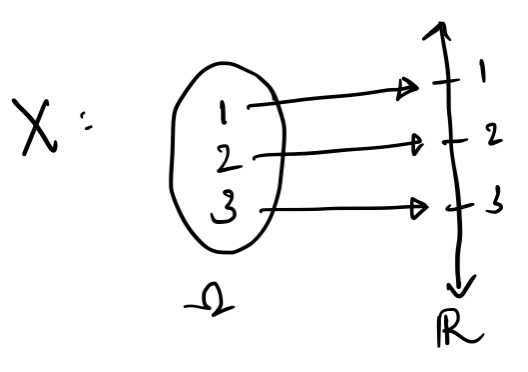
Now, suppose we had to calculate the probability that the random variable
Why then, do random variables need to be measurable functions? Note that the probability measure is only defined for sets in
An example for this is to consider
such that
3. Results on Random Variables
Claim 3.1: If
is a random variable on , then .
A simple (maybe even obvious) claim, the proof is by definition:
Claim 3.2: If
is the indicator of some event , then is a random variable
Proof: for all
The next two claims would be key to proving results about functions of random variables
Claim 3.3: if
and are two measurable functions, then is also a measurable function
Proof: For all
Claim 3.4:
is measurable if .
Proof: Note that
This above claim ensures that we don’t need to prove that every set of a
Claim 3.5: Every continuous function
is measurable.
Proof: from (3.4), it’s sufficient to prove that for every open set
The above three claims give us the following very powerful result: every continuous function of a random variable is also a random variable. We can make a stronger claim, after proving the following claims as well:
Claim 3.6: If
and are random variables on , then and are random variables as well
Proof: This cute proof comes from Rosenthal. It’s sufficient to prove that
Since all the elements in the union belong to
XY is also a random variable, as
We are now free to extend the claim that every continuous function of a random variable is a random variable, to piecewise continuity: every piecewise continuous function of a random variable is also a random variable. If
4. References
- Rosenthal, Jeffrey S. A First Look at Rigorous Probability Theory. World Scientific, 2006. Open WorldCat, http://public.ebookcentral.proquest.com/choice/publicfullrecord.aspx?p=5227675
- Lebanon, Guy, editor. Probability: The Analysis of Data ; Vol. 1. 2012. Available online at http://theanalysisofdata.com/probability/0_2.html
- Math StackExchange, Wikipedia, etc etc :)